Jeff Neese, a biological solutions advisor for BioWorks with more than 35 years in commercial horticulture and integrated pest management, argues that the greenhouse industry is addressing its workforce shortage too late. He makes the case that high-school vocational horticulture can introduce young people to greenhouse production before they choose a career, and that commercial growers should become technical partners to school programs rather than wait for qualified applicants.
The pipeline starts before the job posting
Neese grounds the argument in his own experience at Warren Central High School in Indianapolis. He remembers walking into the school greenhouse during an Indiana winter: cold, gray and dormant outside; warm, humid, green and alive inside. He had vocational horticulture and two teachers, Phil Pitts and Pam Greene. Pitts brought experience as a grower and landscape designer and set high expectations; Greene taught floriculture. Together, Neese says, they showed him horticulture could be a career, not just an interest.
That exposure mattered because Neese did not go to college. He entered horticulture directly and is still working in the field more than 40 years later. He does not diminish university education: the industry needs university-trained horticulturists, plant scientists, breeders, researchers and growers. But college should not be the first place a young person discovers horticulture, he argues, and a four-year degree should not be the only respected route into a professional greenhouse career.
The usual workforce conversation focuses on the shortage of growers with practical production experience, succession planning, recruiting college graduates, developing assistant growers and competing for a limited talent pool. Neese argues that conversation begins too late. A 15- or 16-year-old is unlikely to wake up and decide greenhouse production sounds fascinating. Someone has to show them.
A greenhouse is a living laboratory
Neese supports high-school vocational horticulture but does not claim that placing a greenhouse behind a school is sufficient. A greenhouse is a living laboratory, and operating it well requires knowledge, commitment and time. Agriculture teachers may cover broad subjects. Expecting each of them to be an accomplished grower, crop scheduler, irrigation specialist, diagnostician, IPM practitioner and environmental-control expert is unrealistic, as is expecting teachers to develop those skills alone.
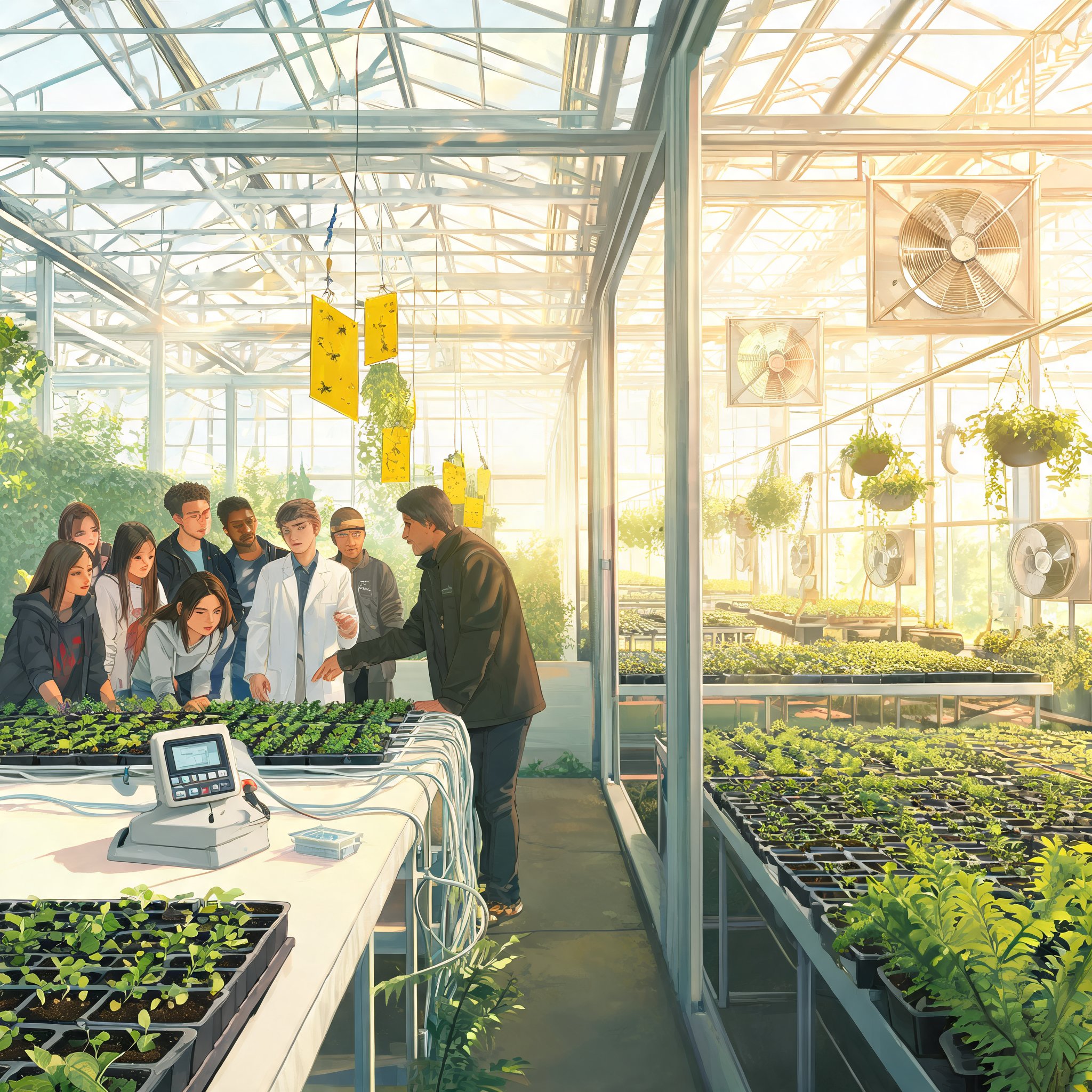
His proposal is for commercial greenhouse operations to “adopt” local school greenhouses in a technical, supportive role, not to take over the greenhouse or dictate curriculum. Growers could help develop an achievable crop plan; set realistic standards for irrigation, fertility, pH, EC, temperature and crop timing; walk the greenhouse with students; and teach scouting rather than simply naming a plant's problem. They could show how sticky cards are used, how roots are examined, how nutritional problems are diagnosed and how growers think through decisions. They could also help teachers use existing equipment and serve as a knowledgeable contact when problems arise.
Summer internships are a snapshot
Neese does not dismiss summer internships but says they are not enough by themselves. For most high-school students, summer is the only extended period for full-time work, and it can provide a narrow view of production. Much of spring's diversity may be over. It is hot and humid. Because the students are inexperienced seasonal employees, they can end up doing whatever job nobody else wants that day: sticking poinsettias, spacing crops, moving plants or cleaning houses.
Those jobs are part of commercial horticulture, but if that is all a teenager experiences, the industry should not be surprised if greenhouse horticulture does not look exciting as a career. The student has experienced greenhouse labor, not necessarily greenhouse management.
To understand growing, students need to see how production changes through the year: fall crops and shortening days; winter's lower light and humidity; spring propagation and peak-production chaos; summer heat, irrigation and preparation for the next cycle. Each stage brings different crops, problems and decisions. An eight-week internship gives a student one snapshot; learning horticulture requires seeing the whole movie.
Connecting the schoolhouse and the greenhouse
Neese wants school and commercial greenhouses to function as extensions of one another. If a grower understands what students are learning in class, the summer internship can become the next chapter of their education rather than an unrelated job. Students who have studied pH and EC can see commercial monitoring. Those who have studied scouting and IPM can join a crop walk. Those who have studied irrigation and fertility can see injectors, water systems and fertilizer programs.
Even repetitive work becomes more meaningful when students understand the decisions behind it. A grower should not simply teach a student to stick a poinsettia cutting. The grower can explain where the cutting fits in the schedule, what happens during rooting, when it will be transplanted, what to watch for and why the finished-crop date matters. The work becomes learning.
Neese also sees a recruiting opportunity. A student might first meet a company as a sophomore taking horticulture classes, visit or work with a grower as a junior and spend a summer with the team. In the senior year, the student could keep developing skills in the school greenhouse while maintaining the relationship. At graduation, the path into horticulture should already be visible.
A respected route beyond college
His argument is not that college is unnecessary. College may be the right next step for many students and should be encouraged. But for students who cannot attend, do not want to attend or, like him, want to start working, there should be another respected path. A talented 18-year-old with vocational horticulture, commercial exposure and mentorship should not be viewed simply as unskilled labor. That person is a young horticulturist at the beginning of a career; the response should be responsibility, continued teaching and a clear view of where the work can lead.
Neese has helped “grow” some of the most rewarding growers he has worked with, he writes. They did not arrive knowing everything; none of us did. They learned the crops and operation from the ground up, took on greater responsibility and gained confidence because someone invested time to teach them. That is more than recruiting. It is developing a horticulturist before young people leave high school.
The limits and the opportunity
The article does not claim that schools can solve the industry's workforce challenges alone, or that growers can solve vocational education alone. The opportunity lies between those worlds. The industry can keep attending career fairs, posting jobs and wondering why applicants lack practical experience. Or growers can get involved earlier: find the local agricultural education program, meet the teacher, walk the school greenhouse, ask what is needed and offer knowledge rather than only old equipment.
Neese urges growers to invite students into their operations in February as well as June, let them scout, test EC, look at roots, see good and problem crops, make mistakes, ask questions and understand the decisions behind a quality crop. When students come to work in summer, growers should give them a reason to want the grower's job someday.
Somewhere, Neese writes, another teenager is walking into a greenhouse for the first time and could become an exceptional grower, IPM specialist, propagator, production manager or greenhouse owner. For him, horticulture was not a fallback if college did not work out; it was the opportunity. More than four decades later, some part of what Pitts and Greene taught him still walks into every greenhouse with him. If the industry is concerned about where the next generation will come from, he argues, it should stop waiting for someone else to produce them. The future may already be sitting in a high-school classroom.