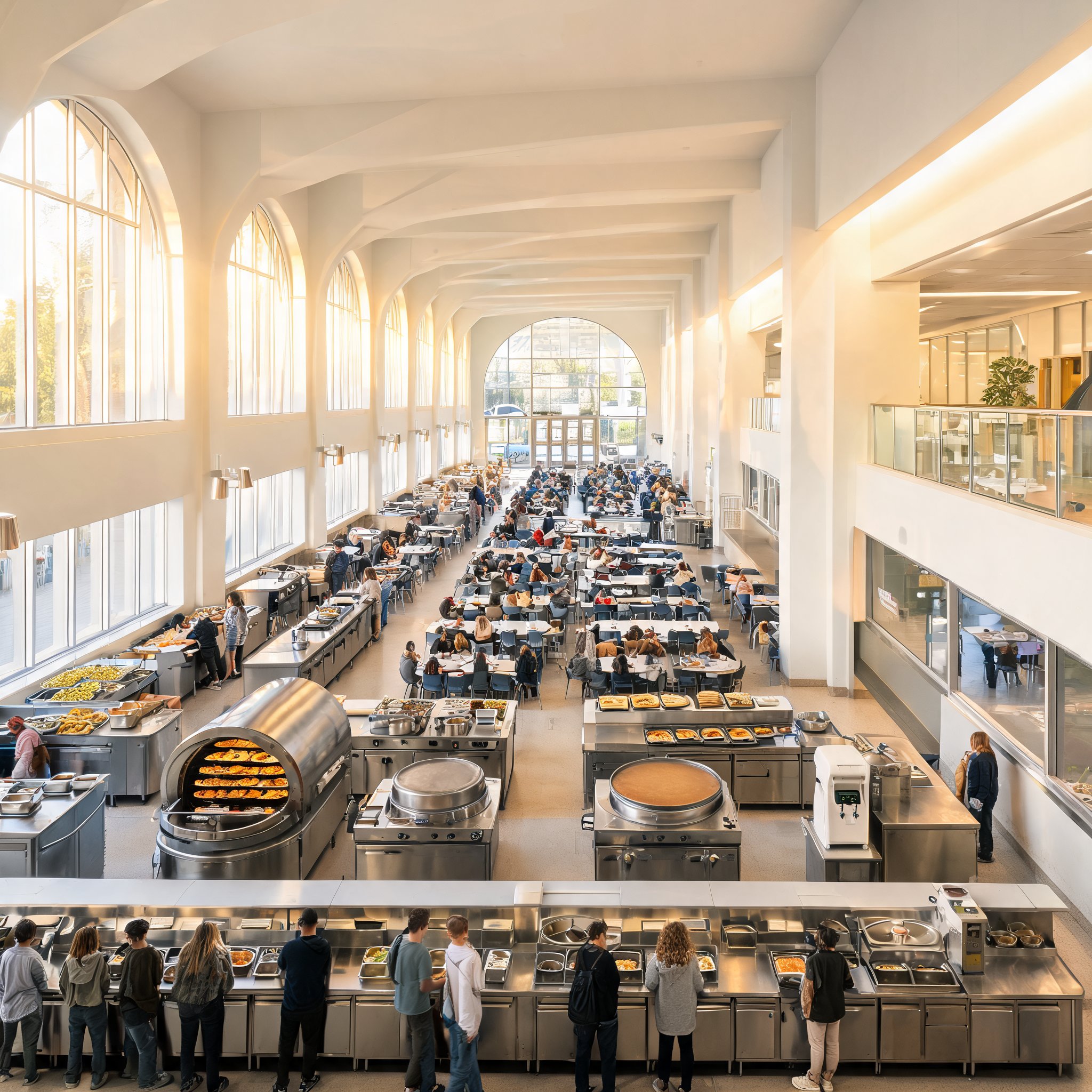
Texas Christian University’s BLUU Dining opened in August 2026 with a clear dual mandate: give students a destination dining hall and lift meal-plan participation as the Fort Worth campus prepares to grow. The facility in the Brown-Lupton University Union is part of a $17 million overhaul and replaces the nearly 18-year-old Market Square. Early results are strong. Less than two months after debut, BLUU Dining was averaging 4,000 meals per day, double the count when the old facility closed for renovation in December 2025. A peak day reached about 5,700 meals, and Associate Vice Chancellor Jude Kiah said the operation could probably produce 8,000 per day if pushed.
The redesign is notable less for a single showpiece than for how it translated student preferences into layout, service and equipment decisions. That makes the project a useful case study in campus foodservice, while also setting a boundary: the early numbers are operational results, not proof that design alone caused the gain.
Research reframed the problem
Planning began in 2022 with surveys of student satisfaction with Market Square. The finding was uncomfortable but actionable: students disliked the facility more than the food. They saw the old hall as a self-serve cafeteria with premade food. They valued made-to-order meals over speed of service and were willing to wait for customization. Kiah said the team ran at least six focus groups and surveys before trusting the result. The observation that students would queue 15 deep without complaint, with the last person served in four minutes and 30 seconds, reinforced the point. The lesson was not simply to add menu variety; it was to design a servery that could handle customization at volume.
Layout turns preference into flow
BLUU Dining covers about 13,000 square feet, with another 4,500 square feet for platforms and back-of-house. It seats 550 inside and 120 on a patio, and it has eight food platforms plus a to-go window. The most consequential move was relocating the salad, deli and to-go platform away from the main servery area. That gave the remaining platforms room to breathe and created a bright destination zone along a wall of windows overlooking campus and the stadium. The university reports that it has become the most popular space.
The to-go window, called Dash, opens into the entrance hallway rather than the servery. That lets time-pressed students pick up a premade sandwich or salad without entering the main dining room. Operationally, it also gives the team a way to capture demand with little labor and potentially operate later in the evening. In effect, the design separates two kinds of service: students who want a quick grab-and-go transaction and those who want a customized meal. Reducing that friction is one mechanism by which a larger, busier hall can avoid turning every visit into a queue.
Back-of-house capacity supports the front
The renovation also addressed the less visible constraints. Facilities director Miles Oller replaced a narrow passageway with a wide service corridor and individual entrances to each platform, so staff and product can move without competing for space. The support kitchen received epoxy flooring and a one-for-one replacement of most 15-year-old equipment. An 800-square-foot walk-in cooler now lets staff roll pallets directly into the cooler and unload onto carts. These are not cosmetic changes. In a made-to-order hall, throughput depends on replenishment, storage and staff movement as much as on cooking speed at the front line.
Equipment chosen for uptime, not spectacle
Equipment decisions followed capacity, flexibility, maintenance and training needs. Interior designers wanted a stone-hearth pizza oven, but the team chose an industrial rotating oven that can produce 116 pizzas an hour and bake casserettes on a lower level. One worker can load from the front while another unloads from the side, avoiding arms in a 550-degree oven. Other choices include a customer-facing soft-serve machine, a round griddle that doubles as a plancha, and a pasta station that can pivot to breakfast. In general, the team favored low-tech, durable equipment over computer-controlled units. It also consulted service representatives on future parts prices and avoided brands with local repair problems. The logic is clear: in a high-volume dining hall, uptime and ease of training can matter more than a dramatic finish.
Early results and the limits of the evidence
The meal-count gains are substantial, but they sit alongside other changes. TCU opened East End on the opposite side of campus in January 2025, revamped menus with Sodexo’s One & All concept, and is preparing to add 2,500 beds next fall. Meal-plan enrollment is 6,300, with expectations of surpassing 8,000 in the coming year. BLUU Dining’s stronger destination appeal may support that growth, but the early totals cannot isolate the redesign’s effect from menu changes, campus growth or broader dining strategy. The theoretical 8,000-meal capacity is also a stated operating estimate, not a sustained result.
Still, the project shows how a campus dining redesign can be organized around a specific behavioral insight: students will wait for made-to-order food if the experience is legible, comfortable and fast enough. BLUU Dining’s contribution is to pair that insight with a servery that separates quick and customized service, a back-of-house that can replenish at volume, and equipment chosen for reliability. Kiah said the hall needed “gravity” compared with East End and is now delivering it. The next test is whether the early traffic holds as enrollment grows and the operation settles into routine.