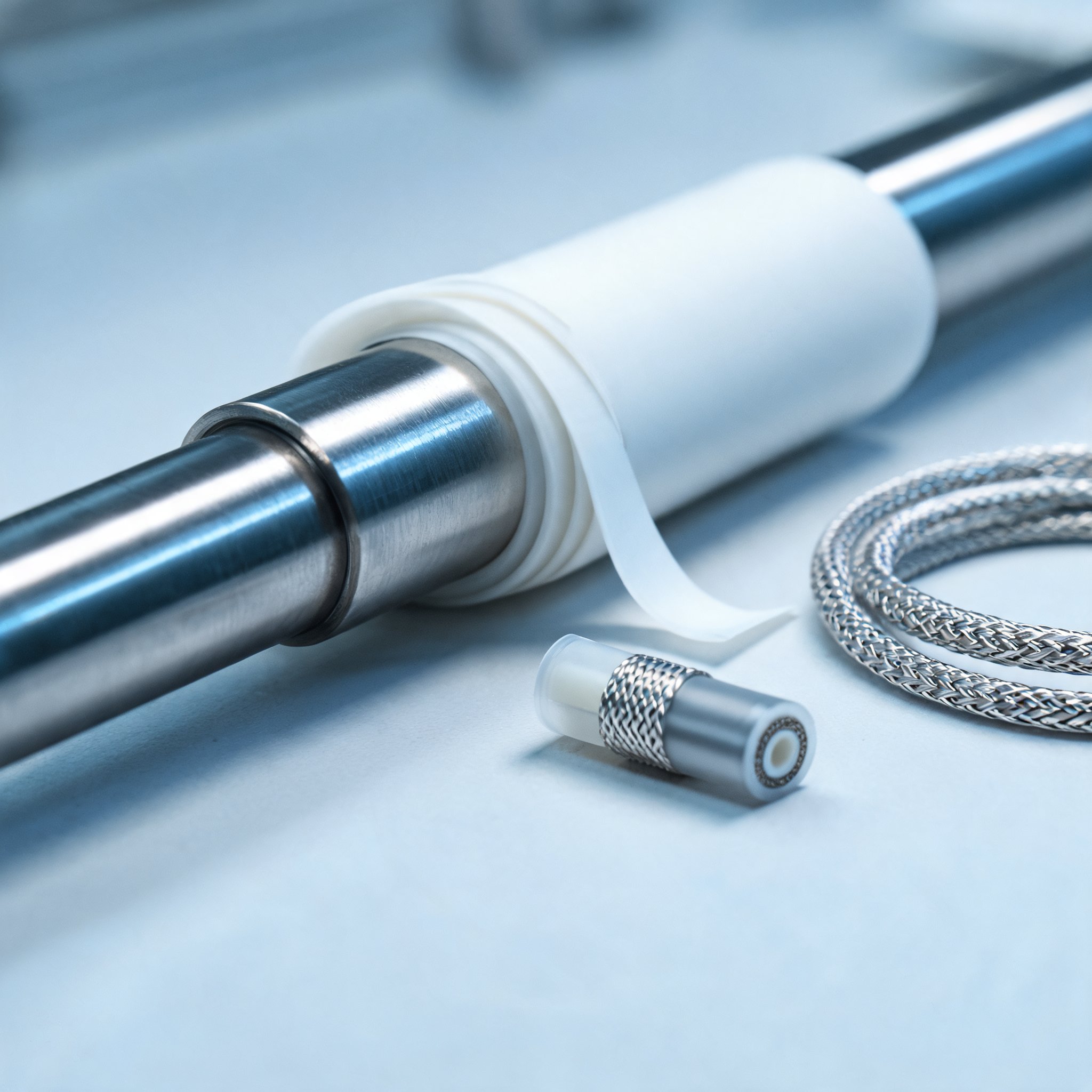
Junkosha announced a new catheter liner category, called Wrapped Liner, at MD&M Midwest in Minneapolis. The company said the category establishes a different approach to liner construction and draws on its experience in fluoropolymer technologies.
Rather than extruding a complete tube, the Wrapped Liner process wraps PTFE film around a mandrel to build the liner wall. Junkosha said it applies proprietary PTFE tape engineering and wrapping technology to create an alternative liner platform. By engineering the tape properties, the company aims to produce a thin, uniform wall with high tensile strength. Junkosha said the platform combines high tensile strength, thin-wall construction and flexibility.
Design trade-offs
According to Junkosha, the approach gives catheter designers and manufacturers more freedom to select finer braid or coil wire or to reallocate space elsewhere in the catheter construction. The stated aim is to balance a low profile with resistance to kinking and ovalization while retaining the flexibility an application needs.
Steve Maxson, founder of Maxson InSight Services, said catheter engineers often describe profile as king, but a low-profile design involves more than reducing wall thickness. He said a catheter still has to resist kinking and ovalization while keeping the flexibility its application requires. Maxson noted that extruded and film-cast liners are already available with very thin walls. In his view, the real opportunity is how thin-wall construction and strength work together to change how engineers approach catheter design.
Small-format focus
Kevin LaDow, chief sales officer of Junkosha USA Inc., described the existing liner options as dip-coated PTFE built up on a mandrel or extruded PTFE supplied as cut-to-length tubing. He said that as the industry heads into 2027, there is a need for a new liner category that is manufactured differently and offers distinct benefits for small-format catheter OEMs.
Junkosha is positioning Wrapped Liner as a scalable platform rather than a single finished product. The company said the platform is intended to support a growing portfolio of solutions tailored to evolving catheter requirements. It also said the approach could extend design possibilities for next-generation devices intended to improve flexibility and broaden the range of anatomies that can be accessed and treated.
The company said the balance of thin, strong and more uniform properties is central to new catheter development because it may allow greater flexibility in how reinforcement is configured. The announcement did not include specific product dimensions, commercial availability dates or clinical performance data. The benefits described are therefore company and expert characterizations of the design approach, not independently verified clinical outcomes.