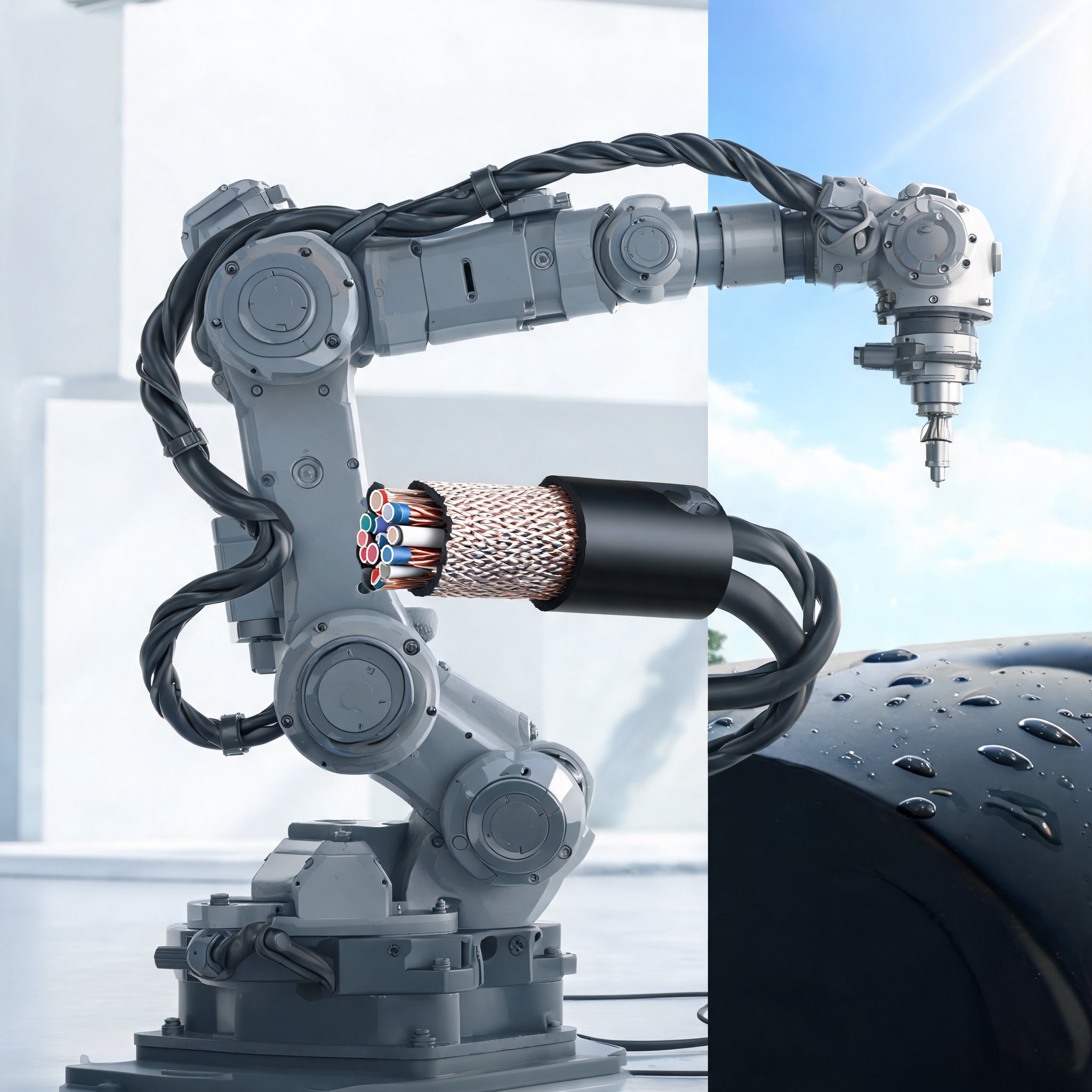
Igus has expanded its CFROBOT8.PLUS robot cable family with a DeviceNet cable built for dynamic robotic applications. The new cable is designed to withstand torsion of up to ±360° per meter, addressing the twisting motion that can occur as robot arms and other moving machinery operate continuously.
The CFROBOT8.PLUS family is engineered for up to 10 million torsional cycles. Igus says the cable uses a specialized shield design that maintains flexibility during continuous robotic movement. The new DeviceNet version also has a reduced outer diameter, up to 21 percent smaller than previous CFROBOT8 models, which the company says makes it suitable for tight installation spaces.
Shield and environmental protection
A tinned-copper braided shield is intended to help maintain signal integrity under demanding conditions. The cable is also oil and UV resistant, allowing reliable use in both indoor and outdoor environments. Those attributes matter for industrial communication cables that must survive repeated motion while protecting data transmission.
Igus identifies six-axis robots, handling systems, machine tools, linear and lead screw systems, and other applications with continuous torsional movement as suitable uses. The DeviceNet cable joins a family that also includes cables for PROFINET, PROFIBUS, CAN bus and Ethernet applications up to CAT7, giving users options across a range of industrial communication systems.
Tested for repeated motion
Like all chainflex cables, CFROBOT8.PLUS cables are tested in Igus’s 5,500-square-meter laboratory under simulated real-world robotic motion. The company says testing has demonstrated reliable electrical performance through more than 15 million cycles.
The launch extends the CFROBOT8.PLUS range into DeviceNet networks while retaining the family’s focus on torsion, shielding and compact installation. For designers working with moving robotic equipment, the cable’s stated torsion rating, reduced diameter and environmental resistance define its intended role; actual service life will depend on the specific motion profile, installation and operating conditions.