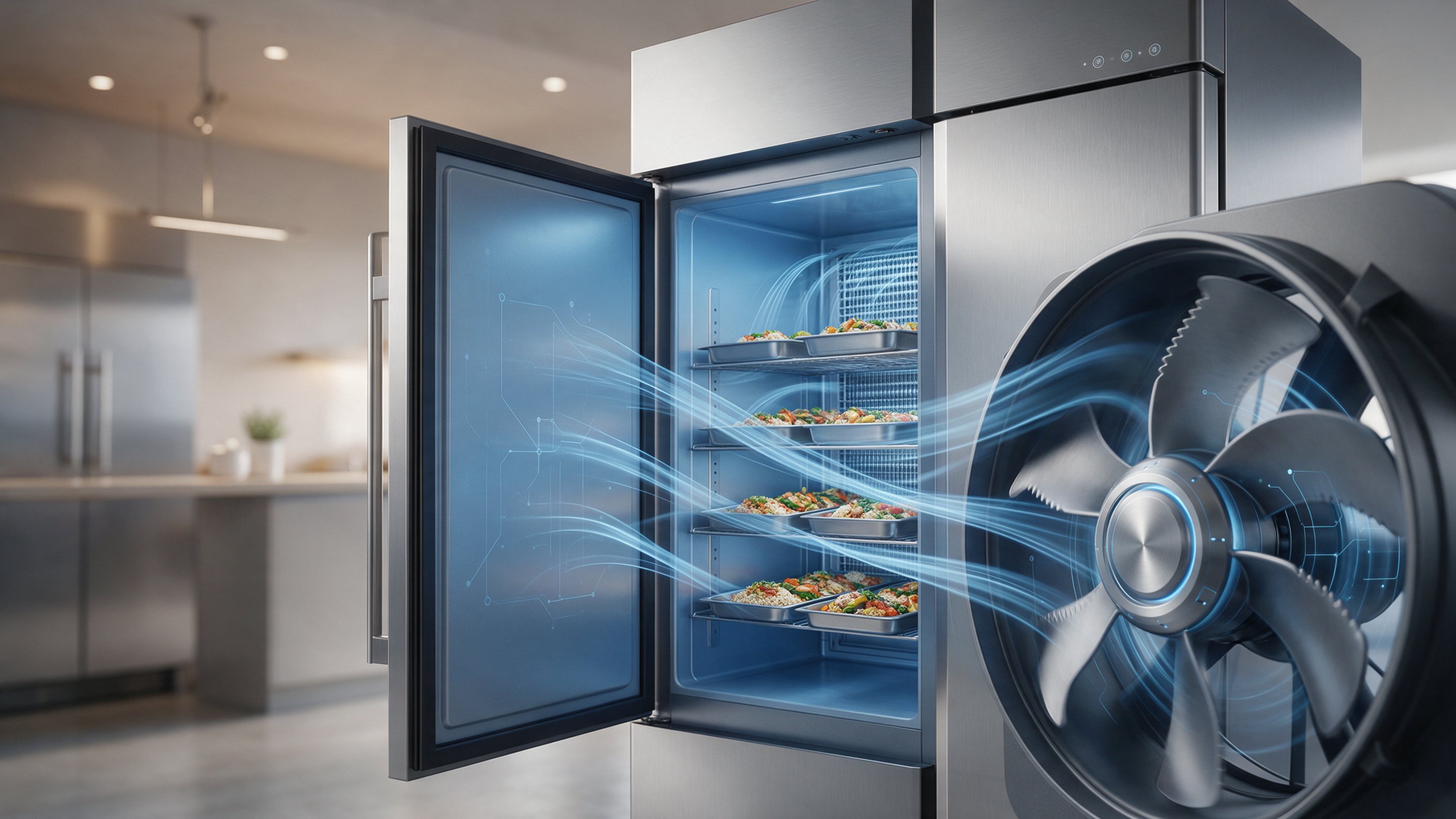
Blast chillers are moving out of the niche once reserved for them in professional kitchens and into the centre of refrigeration system design, as operators weigh food safety against energy bills and tightening European rules. A feature published by Industrial Machinery Digest describes rapid cooling as standard practice across food processing and professional catering, with equipment increasingly judged on airflow, electronics and connectivity rather than cooling capacity alone.
Why rapid cooling matters
Blast chillers work by driving cold air intensively around food, pulling product temperatures from above 70°C to below 3°C in as little as ninety minutes, according to the article. The stated benefits go beyond meeting inspection requirements: faster cooling limits bacterial growth, extends shelf life and does more to preserve texture, moisture, aroma and nutritional value. It also supports production planning and waste reduction in high-volume kitchens, hospitals, hotels, catering operations and food processing plants.
The microbiological argument centres on the “danger zone” between roughly 63°C and 4°C, where microorganisms multiply fastest. Shortening the time food spends in that band is a core principle of HACCP, the hazard analysis system widely applied in the sector — which is why the article frames rapid cooling as a barrier against risk rather than a convenience.
Airflow, not just the refrigeration circuit
Assessments of blast chiller performance often focus on the compressor or evaporator, but the article argues that results depend heavily on how evenly cold air reaches the load. Where air velocity drops or turbulence forms, parts of the product cool more slowly, and those temperature differences can undermine safety, cycle times and final quality.
That has elevated the fan from secondary component to efficiency driver. Electronically commutated (EC) motors combine high electrical efficiency with continuous speed control, letting airflow be matched to each stage of the cooling cycle. Combined with biomimetic impeller designs and composite materials, manufacturers say the result is more uniform air distribution with lower energy use; the article adds that such motors can also replace large external controllers, freeing space inside the cabinet. Lower turbulence is said to cut noise, reduced heat generation is presented as easing the load on the refrigeration system, and gentler operation is credited with extending service life and cutting maintenance.
Digital control and the 2026 regulatory horizon
Current units can select programs by food type, track temperatures through probes and log the whole cycle for traceability — records the article says are valuable in food safety audits. Open protocols such as Modbus allow integration with kitchen infrastructure and building management systems, enabling remote monitoring and predictive maintenance, in which trends in temperature, fan speed, running hours and energy use are used to catch deviations before they become failures.
Regulation is pushing in the same direction. The article notes that the EU Ecodesign framework is broadening beyond energy performance to cover durability, repairability, digitalisation and system-level efficiency, with the Ecodesign for Sustainable Products Regulation (ESPR) marking a turning point. Although measures will be phased in, the 2026 horizon is already shaping design decisions, and performance gains are expected to come from motors, fans, heat exchangers and electronics as much as from the refrigeration circuit.
Suppliers and installers under pressure
The article cites fan maker ZIEHL-ABEGG as an example of the trend, pointing to EC axial fans for commercial refrigeration and food service that combine high-efficiency motors, optimised aerodynamics, low noise and communication over open protocols. That is the company's own positioning, and it reflects a wider shift in which chillers are judged on the combined performance of their parts.
For installers, that means developing expertise in electronics, connectivity and control systems, the article argues, as customers ask for lower running costs and reliability rather than cooling capacity alone — a change that could recast installation professionals as technology advisers across the life of the equipment.